Bendable Digital Radiography for Pressure Vessel and Structural Weld Inspection
A New Era of Precision in Industrial NDT¹²³
Oct 2, 2026
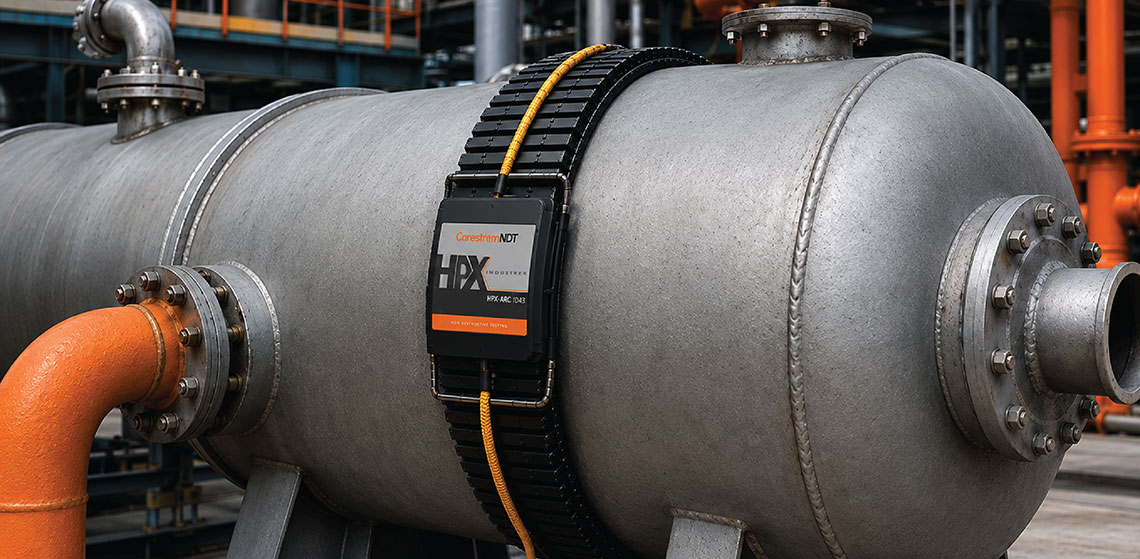
Pressure vessels and structural welds are among the most safety-critical components across industries such as oil & gas, petrochemicals, power generation, shipbuilding, aerospace, and heavy manufacturing. Every weld, joint, and curved surface must withstand enormous operational stress, making inspection accuracy non-negotiable. A missed defect can lead to catastrophic equipment failure, costly downtime, environmental damage, or even loss of life. ¹² For decades, industrial radiography has relied on film or rigid digital detectors to inspect these critical assets. While these technologies have served the industry well, they often struggle when inspecting curved geometries, small-diameter pipes, pressure vessels, nozzles, and complex welded assemblies. The inability of rigid detectors to conform to curved surfaces can introduce image distortion, inconsistent detector positioning, and increased inspection complexity. This is where bendable Digital Radiography (DR) is transforming industrial inspections. Designed to adapt to the shape of the component rather than forcing the inspection around equipment limitations, bendable DR detectors are redefining how inspectors approach pressure vessel and structural weld evaluation—delivering faster workflows, higher image quality, and greater operational flexibility.
Why Curved Components Have Always Been Challenging
Pressure vessels rarely present perfectly flat inspection surfaces. Cylindrical shells, curved pipe sections, saddle joints, elbows, nozzles, and circumferential welds all introduce geometric complexities that make traditional imaging difficult. With rigid detectors, inspectors often encounter air gaps between the detector and the inspection surface, multiple repositioning cycles, reduced image consistency, decreased geometric sharpness, longer inspection times, and greater operator fatigue. Each repositioning introduces opportunities for misalignment, repeat exposures, and productivity losses. When inspections involve hundreds of welds across large industrial facilities, these inefficiencies quickly become significant operational costs. ¹
Pressure Vessel Inspection Benefits
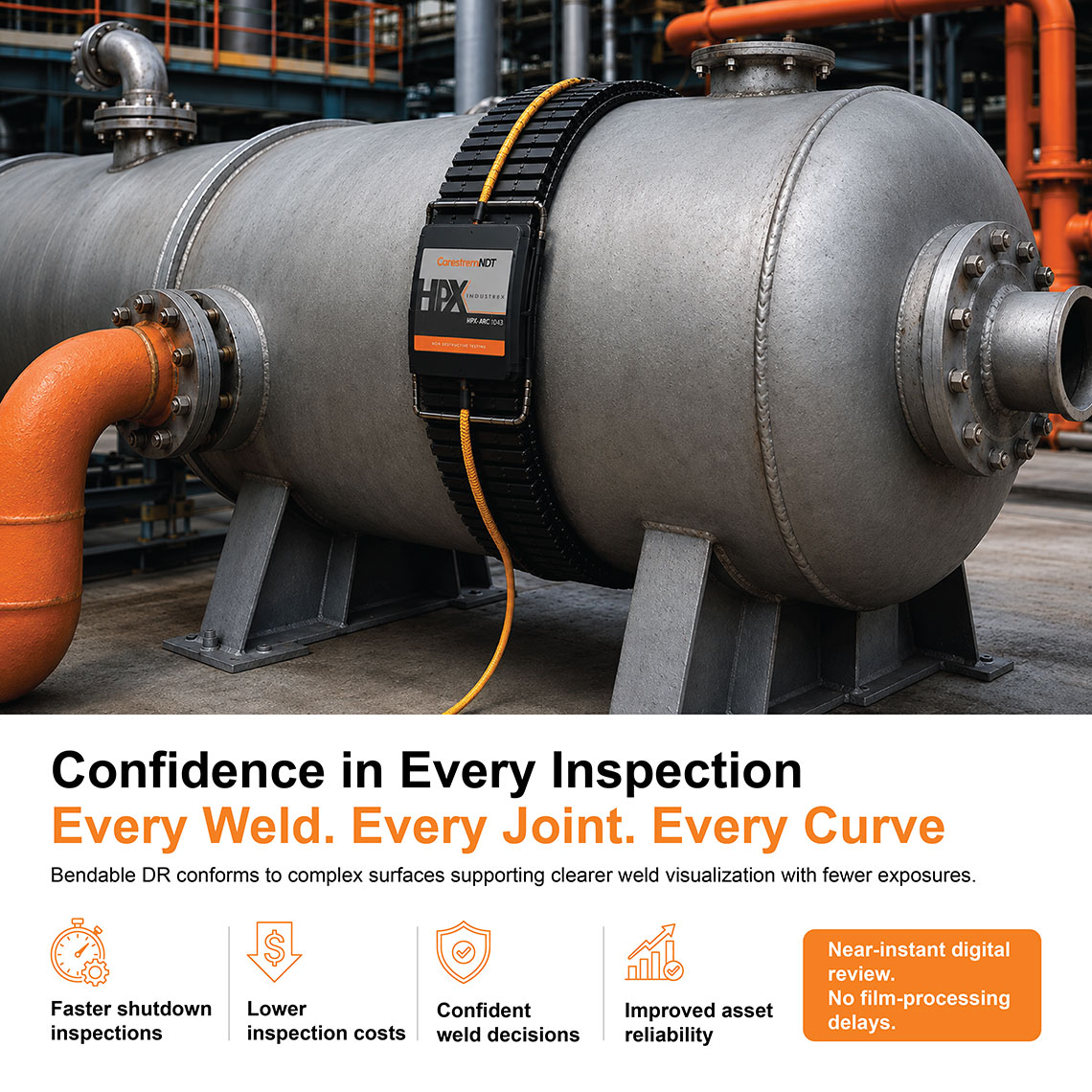
Pressure vessels operate under extreme pressure, temperature, and cyclic loading conditions. Even small discontinuities such as lack of fusion, porosity, slag inclusions, or cracking can compromise structural integrity. Bendable DR enables inspectors to capture clearer images across the vessel's curved shell without sacrificing detector positioning. This improves visualization of defects while reducing the number of exposures needed to inspect circumferential welds. For asset owners, this means faster turnaround during shutdowns, reduced inspection costs, higher confidence in weld acceptance decisions, and improved asset reliability. Digital workflows also eliminate film processing delays, allowing inspection teams to review images almost instantly and make faster maintenance decisions.
Structural Weld Inspection Made More Efficient
Structural welds are found everywhere, from bridges and offshore platforms to cranes, heavy equipment, wind towers, pipelines, and industrial infrastructure. Many of these welds are difficult to access because of their orientation, surrounding structures, or complex geometry. Bendable DR offers significant flexibility for inspecting T-joints, fillet welds, pipe-to-flange welds, nozzle welds, saddle welds, and circumferential pipe welds. Because the detector conforms to challenging surfaces, inspectors spend less time adjusting equipment and more time performing productive inspections. This improves workflow consistency while helping organizations meet demanding project schedules.
Higher Productivity Without Sacrificing Image Quality
Inspection speed should never come at the expense of defect detectability. Modern bendable DR solutions combine flexibility with advanced detector technology to deliver high-contrast digital images capable of identifying subtle discontinuities. Compared to traditional film radiography, digital radiography offers immediate image acquisition, wider dynamic range, digital image enhancement, faster reporting, simplified image storage, and easier collaboration between inspection teams. Many systems also integrate seamlessly with digital inspection software, enabling traceable workflows, standardized reporting, and long-term archival without the challenges associated with physical film management. ²
Supporting Safer Industrial Operations
Every inspection ultimately supports one objective and that’s ‘operational safety’. Whether inspecting refinery pressure vessels, LNG storage systems, fabrication welds, or power plant components, reliable imaging helps maintenance teams identify potential issues before they evolve into costly failures. Earlier defect detection enables organizations to schedule proactive maintenance, extend equipment life, reduce unplanned shutdowns, improve regulatory compliance, and strengthen overall asset integrity programs. As industrial facilities continue moving toward predictive maintenance and digital asset management, advanced DR solutions fit naturally into modern inspection ecosystems.
The Future of Weld Inspection Is Flexible
Industrial NDT is evolving rapidly. Today's inspection teams are expected to deliver faster results, improve productivity, reduce downtime, and maintain the highest levels of quality assurance—all while working in increasingly complex environments. Bendable Digital Radiography addresses many of the long-standing limitations associated with conventional radiographic inspection by combining portability, adaptability, and digital precision into a single inspection solution. Rather than treating curved surfaces as a challenge, flexible DR technology embraces them. As pressure vessels become more complex and infrastructure projects continue to expand globally, bendable digital radiography is poised to become an essential tool for inspectors seeking greater efficiency, improved image quality, and enhanced inspection confidence. The future of industrial radiography is no longer defined by rigid equipment; it is defined by technology that adapts to the inspection itself.
Unmatched Benefits
Pressure vessel and structural weld inspections demand accuracy, repeatability, and speed. Bendable Digital Radiography brings these capabilities together by overcoming the geometric limitations of traditional rigid detectors while enabling faster, higher-quality inspections. For organizations committed to improving operational efficiency, maintaining compliance, and protecting critical infrastructure, flexible DR technology represents more than an incremental improvement, it marks a meaningful advancement in the evolution of industrial Non-Destructive Testing.
Learn more: https://www1.carestream.com/IndustrexHPXARC
As industrial assets become more complex, inspection technologies must evolve alongside them. Bendable Digital Radiography empowers inspection professionals to achieve greater accuracy, streamline workflows, and confidently evaluate challenging curved geometries without compromising image quality.
Discover how next-generation flexible DR solutions can enhance your pressure vessel and structural weld inspection programs while supporting safer operations, faster decision-making, and long-term asset reliability.
Frequently Asked Questions
-
Why are flexible DR detectors useful for inspecting curved pressure vessels and pipes?
Ans: Flexible DR detectors can conform to curved surfaces that are difficult to inspect with rigid detectors. Better conformity can help reduce positioning challenges, air gaps, and repeated detector adjustments, making it easier to achieve consistent imaging across circumferential welds, pipes, nozzles, and pressure vessel shells. -
What are the benefits of bendable DR for pressure vessel weld inspection?
Ans: Bendable DR can simplify detector positioning around curved vessel surfaces, reduce repositioning, and support faster digital image acquisition. It can help inspectors efficiently evaluate welds while maintaining an appropriate inspection setup for the component geometry. -
Can bendable digital radiography improve structural weld inspection?
Ans: Yes. Flexible DR can make it easier to position detectors around challenging weld geometries, including pipe-to-flange, saddle, circumferential, and other curved welds. This can reduce setup difficulties and improve workflow efficiency during structural inspections. -
How does a flexible DR detector compare with a rigid detector for curved surfaces?
Ans: A flexible DR detector can conform more closely to curved surfaces, whereas rigid detectors maintain a flat geometry. This flexibility can simplify positioning and reduce gaps when inspecting curved components, potentially making the inspection process more efficient. -
Does bendable DR make industrial weld inspections faster and more efficient?
Ans: Bendable DR can streamline inspections by reducing detector repositioning and enabling immediate digital image review. Combined with digital image processing, storage, and reporting, it can help inspection teams reduce workflow delays and improve overall operational efficiency.
References & Citations
1 Carestream NDT – HPX-ARC Bendable Digital Radiography
https://www.carestream.com/en/us/nondestructive-testing-ndt-solutions/hpx-arc-1043-ph-digital-solution
2 American Society for Nondestructive Testing (ASNT)
https://www.asnt.org
3 ASTM International – Digital Radiographic Testing Standards (e.g., ASTM E2737, ASTM E2698)
https://www.astm.org