Optimizing Pipeline Inspection Productivity with Bendable Digital Radiography
How the INDUSTREX® HPX-ARC 1043 PH Digital Solution Is Helping Pipeline Operators Inspect Faster, Smarter, and with Greater Confidence
Sep 28, 2026
Pipelines Power Modern Infrastructure; Inspection Keeps Them Reliable
From transporting crude oil and natural gas to delivering chemicals and water across vast distances, pipelines are among the world's most critical industrial assets. Yet their reliability depends on one essential practice: consistent, high-quality inspection. Whether evaluating newly welded pipelines during construction or assessing aging infrastructure for corrosion and structural integrity, Non-Destructive Testing (NDT) enables operators to identify defects before they become costly failures. As pipeline networks continue to expand and inspection demands increase, operators are under growing pressure to complete inspections more quickly & without compromising image quality, safety, or regulatory compliance.¹ This is where Digital Radiography (DR) is transforming industrial inspection workflows. Unlike traditional film-based radiography or conventional Computed Radiography (CR), Digital Radiography delivers high-resolution images almost immediately after exposure, enabling inspectors to validate results in real time and make faster, more informed decisions. ¹ Leading this shift is the INDUSTREX® HPX-ARC 1043 PH, Carestream's bendable Digital Radiography detector specifically engineered for inspecting larger curved industrial assets such as pipelines, pressure vessels, and storage tanks.²
Why Productivity Has Become a Critical Inspection Metric
Pipeline inspection has always required precision, but today's projects demand precision and speed. Inspectors often work within tight shutdown windows, remote locations, offshore environments, and active construction sites where delays can significantly impact project schedules and operational costs. Traditional film radiography has long been regarded as the industry benchmark for weld inspection, but the workflow remains labour intensive. Every inspection typically involves detector positioning, radiation exposure, film retrieval, chemical processing, drying, image interpretation, and physical archiving. Computed Radiography simplified portions of this process by replacing film with imaging plates, yet technicians must still transport and scan those plates before images become available. Across projects involving hundreds or even thousands of welds and these additional workflow steps can accumulate into hours or even days of lost productivity.¹ Modern inspection teams are therefore looking beyond image quality alone. They're seeking technologies that reduce bottlenecks, improve efficiency, and help inspectors make confident decisions while they're still on-site.
Digital Radiography Changes the Inspection Workflow
Digital Radiography fundamentally changes how industrial inspections are performed. Instead of waiting for images to be processed after exposure, inspectors receive digital results within seconds, allowing immediate verification of image quality and weld coverage. ¹ This instant feedback creates measurable workflow improvements throughout the inspection process. Rather than discovering positioning errors after returning to a processing station, technicians can immediately confirm image quality, reposition the detector if necessary, and continue with the next inspection while remaining in the field. These efficiencies help organizations accelerate inspection cycles, reduce repeat exposures, minimize radiation time, improve first-pass inspection success, speed up reporting and engineering review, and increase asset availability by reducing unnecessary downtime. Ultimately, Digital Radiography transforms inspection from a sequential process into a more agile, data-driven workflow that supports faster operational decisions.
Why Pipeline Geometry Demands Flexible Imaging
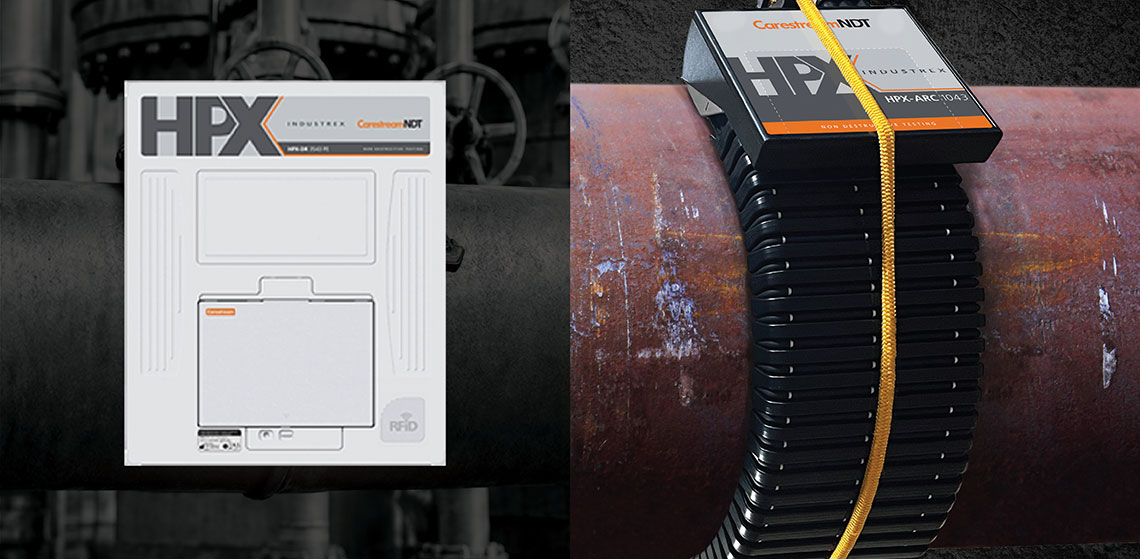
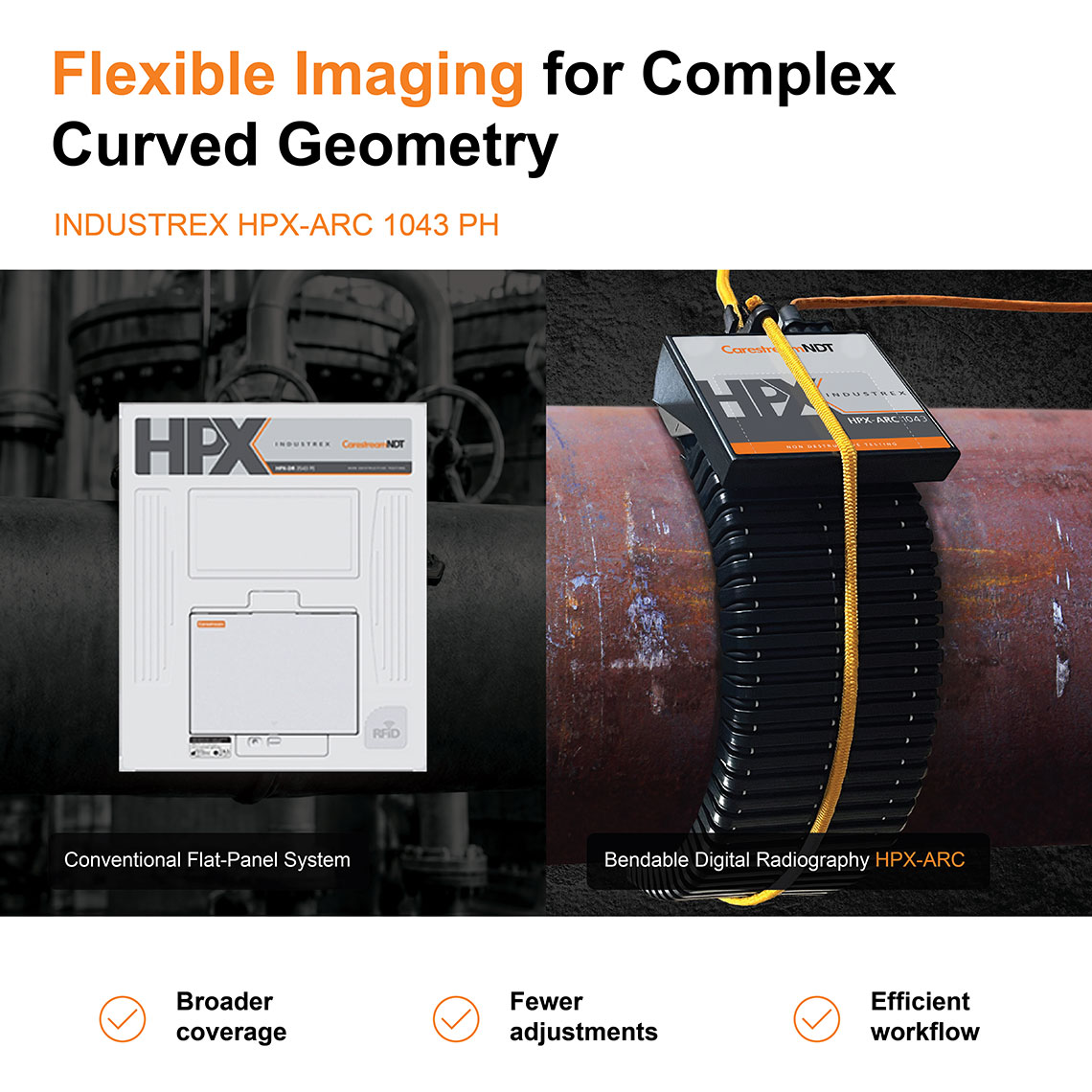
Pipelines rarely present ideal inspection conditions. Curved pipe surfaces, circumferential welds, elbows, tees, and other complex geometries often make detector positioning difficult when using conventional rigid flat-panel systems. Maintaining close contact between the detector and the inspection surface may require multiple detector placements or repeated exposures, increase inspection time, and reduce productivity. Flexible Digital Radiography addresses this challenge by allowing the detector to conform naturally to the curvature of the pipe. Improved detector positioning enables broader inspection coverage, fewer setup adjustments, and a more efficient workflow, all while maintaining the image quality required for critical weld evaluations. For pipeline contractors, owner-operators, and inspection service providers, these incremental improvements can deliver substantial productivity gains across large-scale projects.
Introducing the INDUSTREX® HPX-ARC 1043 PH
Purpose-built for demanding industrial environments, the INDUSTREX® HPX-ARC 1043 PH combines high-resolution Digital Radiography with the flexibility required to inspect larger cylindrical assets efficiently. ² Its 4 × 17-inch (10 × 43 cm) active imaging area allows inspectors to capture longer weld sections in a single exposure, improving coverage while reducing detector repositioning.² The detector can bend around pipes as small as 4-inch Nominal Pipe Size (NPS) (approximately 114 mm outside diameter), making it particularly well suited for pipeline inspections where conventional rigid detectors may struggle to achieve optimal positioning. ² Featuring a 98-micron pixel pitch, the HPX-ARC 1043 PH delivers exceptional image detail for identifying critical discontinuities while supporting faster inspection workflows.² Its rugged IP67-rated enclosure is engineered to withstand demanding industrial environments, providing reliable performance in dusty, wet, and challenging field conditions. ² Compatible with both Gamma and X-ray radiation sources, the detector offers flexibility across a broad range of pipeline construction, maintenance, integrity assessment, and field inspection applications. ² Rather than changing how inspectors work, the HPX-ARC 1043 PH enhances their existing expertise by helping them acquire high-quality digital images more efficiently, allowing inspection teams to focus on what matters most, making informed decisions that protect critical infrastructure.
Looking Beyond Image Quality
For decades, industrial radiography has focused on producing high-quality images. Today, however, the conversation has evolved. Leading pipeline operators increasingly recognize that inspection productivity depends not only on image clarity but also on how quickly those images become actionable information. The ability to position a detector efficiently, capture an image instantly, review results on-site, and confidently move to the next inspection represents a significant competitive advantage in modern pipeline integrity programs. As the industry continues its transition toward digital workflows and connected asset management, bendable Digital Radiography solutions such as the INDUSTREX® HPX-ARC 1043 PH are helping inspection teams improve efficiency, reduce operational delays, and build more resilient inspection programs for the future.
Conclusion
Optimize Every Inspection. Maximize Every Project. Pipeline inspections are becoming more demanding, with tighter schedules, evolving compliance requirements, and increasing expectations for productivity. Equipping your inspection team with the right digital radiography technology can help reduce workflow bottlenecks, improve inspection efficiency, and deliver faster, more confident decisions in the field. The INDUSTREX® HPX-ARC 1043 PH combines the flexibility of a bendable detector with the speed of Digital Radiography to help inspectors capture high-quality images on curved pipeline assets without compromising performance or reliability. Ready to modernize your pipeline inspection workflow?
Discover how the INDUSTREX® HPX-ARC 1043 PH can help accelerate inspections, improve productivity, and support smarter asset integrity management. Explore the solution or connect with a Carestream NDT specialist today.
Learn more: https://www1.carestream.com/IndustrexHPXARC
Frequently Asked Questions
-
How does digital radiography eliminate traditional film processing delays in NDT?
Digital Radiography captures X-ray data electronically, making images available almost immediately after exposure. This eliminates film processing, drying, and manual handling, allowing inspectors to review images and make decisions faster. -
How does flexible digital radiography conform to pipeline curvature and improve detector positioning?
A flexible DR detector can conform to the contour of curved surfaces such as pipelines, helping inspectors position the detector more effectively around the component. This can improve coverage while reducing the positioning challenges associated with rigid detectors. -
How can detectors that bend around 2-inch NPS pipes improve pipeline inspection efficiency?
The HPX-ARC 1025 PH can bend around pipes as small as 2-inch NPS, allowing inspectors to image smaller curved components without relying on a rigid detector. This flexibility can simplify positioning, support efficient image acquisition, and reduce workflow complexity. -
What role does 98-micron pixel pitch play in identifying critical weld discontinuities?
The HPX-ARC 1025 PH features a 98-micron pixel pitch, supporting high-resolution digital imaging. This allows fine image details to be captured, which can be important when evaluating welds and other components for potential discontinuities. -
How does IP67-rated enclosure design enable reliable performance in demanding field conditions?
The IP67-rated construction helps protect the detector against dust and water exposure, supporting reliable operation in demanding industrial environments. This makes it better suited for field inspections where environmental conditions can be challenging. -
What advantages does on-site image review provide for pipeline owner-operators and inspection contractors?
Immediate image availability allows inspection teams to verify image quality while still on-site, identify positioning issues, and make corrections before leaving the inspection location. This can help reduce repeat exposures, minimize return visits, and keep inspection workflows moving efficiently.
References & Citations Links
1 Carestream NDT. INDUSTREX® HPX-ARC 1043 PH Digital Solution.
https://www.carestream.com/en/us/nondestructive-testing-ndt-solutions/hpx-arc-1043-ph-digital-solution
2 Carestream NDT. INDUSTREX® HPX-ARC 1043 PH Product Brochure.
https://www.carestream.com/en/us/-/media/publicsite/products_and_solutions/ndt/carestream_hpx-arc_brochure_7700600_202501_ltr_en_lores.pdf
3 Carestream NDT. INDUSTREX Digital Viewing Software.
https://www.carestream.com/en/us/nondestructive-testing-ndt-solutions/software
4 ASTM International. Standards for Digital Radiographic Examination (E2698, E2737, E2445).
https://www.astm.org